
The TDI Intro to Tech Course is an introductory course that expands on recreational training by improving dive planning methods, in-water skills, and streamlining existing gear configurations in a controlled and fun learning environment.
Who this course is for:
Course prerequisites:
(these requirements must be met prior to the start of the course):
Are you looking to expand your dive time? Maybe you’re a scientific diver or photographer looking to stay in the water a little longer?
The TDI Advanced Nitrox Course qualifies divers to use enriched air nitrox from EAN 21 through EAN 100 percent within your current certification level to a maximum depth of 40 metres/130 feet during dives that do not require staged decompression.
Often taught in conjunction with the TDI Decompression Procedures course, this can be considered the foundation of your technical diving career. TDI Advanced Nitrox is also a must for SCR or CCR divers.
Who this course is for:
Course prerequisites:
(these requirements must be met prior to the start of the course):
The TDI Intro to Tech Course is an introductory course that expands on recreational training by improving dive planning methods, in-water skills, and streamlining existing gear configurations in a controlled and fun learning environment.
Who this course is for:
Course prerequisites:
(these requirements must be met prior to commencement of training):
The TDI Helitrox Diver Course examines the theory, methods, and procedures for planning staged decompression dives utilizing helium in the breathing mixture to reduce the effects of inert gas narcosis.
The TDI Helitrox Diver Course trains divers how to plan and conduct staged decompression dives to a maximum depth of 45 metres/150 feet. The most common equipment requirements, gear set-up, and decompression techniques are also presented during this course. Students are permitted to utilize enriched air nitrox and helium mixes with no greater than 35% helium content, and up to 100% oxygen for decompression diving.
This program is designed as a stand-alone course, or it may be taught in conjunction with TDI Advanced Nitrox at the discretion of the instructor.
Who this course is for:
Course prerequisites:
(these requirements must be met prior to commencement of training):
Certain areas of the world provide spectacular dives at depths deeper than 39 metres/130 feet but you may not have access (or very limited access) to helium.
The TDI Extended Range course teaches you the proper techniques for utilizing compressed air as a breathing gas, and with a maximum depth of 55 metres/180 feet, so you don’t have to miss those dives!
The TDI Extended Range Diver Course provides the training and experience necessary including proper techniques, equipment requirements, and hazards of deep air diving, to competently utilize air for dives up to 55 metres/180 feet that require staged decompression, using nitrox mixtures or oxygen during decompression.
While the course requires only 4 dives (2 training dives, 2 deco dives) to complete, here at Maldives Technical Diving we believe that 1 extra dive is incredibly beneficial to maximise student confidence and safety. If needed, this additional experience enhancing dive is included in the price of the course.
Who this course is for:
Course prerequisites:
(these requirements must be met prior to commencement of training):
Are you looking to expand your depth range? Do you want to reduce narcosis during deep dives? The TDI Trimix Diver Course could be your next step! As your motivation to explore progresses, you will find that you may want to go deeper to dive that wreck that is part of history or that cave system that you have read so much about.
One of the major limiting factors of going deeper is narcosis; TDI’s Trimix Diver course shows how to minimize the effects of narcosis by adding helium to offset the nitrogen in your breathing gas. While taking the Trimix Diver course your TDI Instructor will teach you how to plan and execute dives utilizing as little as 18 percent oxygen and diving to maximum depth of 60 metres/200 feet with a blend of helium appropriate for the planned depth.
Who this course is for:
- Extend their depth range
- Reduce narcosis for all deep dives
- Advance their technical diving education
Course prerequisites:
(these requirements must be met prior to commencement of training):
The TDI Advanced Trimix Diver Course is the top level of training for open circuit divers wishing to dive to depths as deep as 100 metres/330 feet utilizing hypoxic levels of oxygen (below 17 percent).
This course is perhaps one of the most informative and challenging of all of the TDI open circuit courses. Upon completion, you will be among some of the most elite divers, capable of doing and seeing more while diving than any other divers out there.
Who this course is for:
- Extend their depth range
- Advance their technical diving education
Course prerequisites:
(these requirements must be met prior to commencement of training):
All of the Maldives Technical Diving courses are delivered utilizing TDI online e-learning theory packages. Experience has shown that the majority of students find this approach is better suited to their individual learning needs being more flexible, easier to align with their available time and the pace of their learning.
The e-learning packages are specifically developed to track progress and allow your instructor to identify areas for further discussion during the classroom reviews before the practical elements of the course begin. Traditional classroom based theory is also offered when e-learning is not possible or suitable.
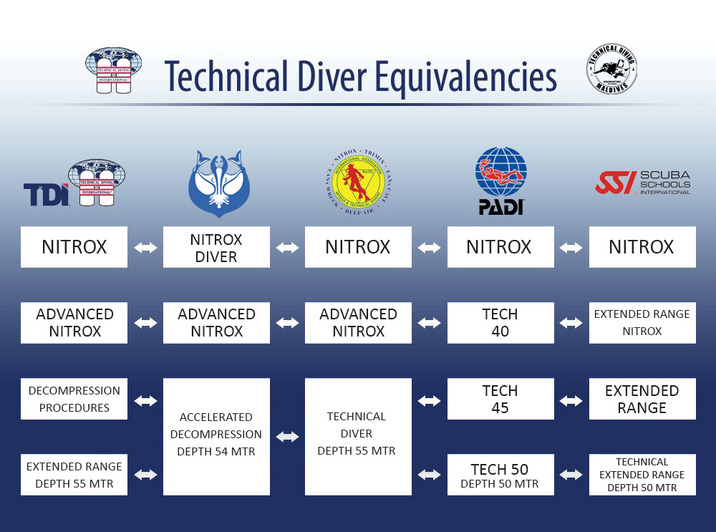
First and foremost, not all technical diver ratings are created equal. Every training agency takes a different approach when it comes to the flow path for creating technical divers. Throw in helium, rebreathers, cave diving, sidemount, etc. and the flow path begins to look more like a tangled complicated web of options. And that’s just for each agency; now imagine crossing back and forth from one agency to the next, and it becomes a nearly unmanageable maze. But we’re going to try to break it down for you here (OPEN CIRCUIT-NON OVERHEAD DIVER).



Maldives Technical Diving © 2026 | Legal Notice | Privacy Policy